Saturday, 18 July 2015

Policy Ponderings

It may be summertime but I've had teaching on my mind a lot lately. Not so much the 'what' of teaching, more the 'how'. I spent a week at an enrichment camp for kids. I was leading a couple of technology programs for children from Grade 1 - 6. All of the camp leaders were teachers, some OT's and a few retirees. At lunches and breaks we talked school. I followed this with a 3 day technology session in Simcoe County surrounded by teachers from different boards. After the inevitable, 'What is your role in education?' conversation, most of the discussions centred around 'how' questions. 'How do you integrate technology?
http://goo.gl/IUIso9
How do you connect it to curriculum? How do you ensure students use it safely? How do you assess learning? How do you use it to assess learning?' After a few days of addressing these common concerns, I asked the group if I could pose a few questions to them. They were willing. I surveyed the crowd, met with a few individually, and had some interesting results. I asked about technology policies and guidelines in their teaching environments. I asked about what is available and what they use. My survey group consisted of teachers from Waterloo Region and the boards between Toronto and Sudbury including Prince Edward-Hastings, a total of 10 boards, 50 teachers. I thought there would be more inconsistency in the results. All of them lamented over the lack of Professional Development offered in their districts. Many commented about how the technology just 'arrives' and they are expected to figure it out, logistically, technically and pedagogically. Most had access to iPads at their school or had a small set in their rooms. Many teachers had a device 'assigned' to them but very few were aware of or could summarize the policies of their board. Many had a contact person to call if they needed a password or wanted software or an app added. The only piece of hardware that teachers were given any guidelines about were cellphones. All knew whether they were allowed or not. Most schools were very strict, others had exceptions for junior aged students. Within boards it seemed to depend on the administrator of the school. "I'm lucky, I have a principal who supports technology." was said by a few. They were all very interested to see the BYOD parent letter that I use at my school. I wasn't going to ask how many used their own devices in the classroom but they were willing to answer. It was over 80%.
Even though they were generally aware that their boards and the ETFO union strongly advises them not to use them at school, teachers do. I asked a few individuals about this. They said 'I know how to use my own personal device, no one has taken the time to show me how to use the board stuff, they just say here you go and wait for me to say thank you.' Eventually my large group survey led to deep concerns about their safety and the safety of students online. Every teacher wants to do the right thing, but they all want/need someone to guide them. Every teacher in the room wanted to use technology more, all want/need more PD. I was there to give them some 'whats' to do with iPads. I know now that technology leaders need to include more connections to the 'hows' involving policy. Much thanks to my new friends who were willing to give up some time in July to try and wade through this wonderful field of technology in the classroom with me.


Friday, 17 July 2015

A Few Things to Consider...

If we as teachers are not educating our students about the correct and responsible use of the digital world then we are doing them a disservice. Every day in the classroom I should be preparing students for the real world. The real world involves technology. Therefore, regardless of any outdated policies or curriculum I should be, no, must be, including the use of technology in my program. With that given firmly established, what needs to be considered? Legal perspectives, such as age requirements, use of photos, copyright etc. and ethical issues must be given some attention. Well, the first three considerations seem to be easily determined by terms of agreement and ever evolving copyright laws. But what are the ethical issues in technology anyway? My working definition of 'ethics' has been, 'What is the best way for people to live?' Hmm, that's quite subjective. If ethics drive law and policy as they have in the Canadian Charter of Rights, that would mean front line teachers are really counting on board and ministry leadership to interpret all the questions about digital use in a classroom. For example, should student blogs be visible publicly? The Edublogger attempts to answer this one..."No matter the age or experience, we believe that blogs are meant to be public." This article considers the pros and cons of blogging as an educational tool and offers up some good advice for public viewing of work. But would our educational leaders agree with the 'experts'? It is difficult to put the benefits of a learning experience on the same weigh scale as policy.
https://goo.gl/XOU7s9
My readings and conversations also led to an interesting dilemma that I fortunately have not had to deal with in a classroom.  Is using technology in a classroom increasing 'cheating'? Followed by, do some students bring their devices into class to help them with exams and tests? Not surprisingly, when presented with a scenario such as this, there are all kinds of solutions discussed. 1) Ban them during the test  2) Make a test that isn't  'googleable'.  3) Create a test that requires a device. 4) Ban cell phones or do not encourage BYOD.  These 4 were the most popular in conversations and articles online.  I personally like 2 and 3.  They encouraged embracing technology and using it for good.  The Ontario College of Teachers reminds us that 'care, trust, respect and integrity are the cornerstones' of the ethical standards we must follow.  It is something we should keep in mind every time, either a student or a teacher, picks up a device in the classroom. 
There are many questions that need to be considered and then considered again.  For teachers, a big one is as follows. With technology being so pervasive in our society how do we deal with issues not covered by our policies and guidelines?  It is something to ponder carefully. What do you think?


Sunday, 12 July 2015

How Will We Know?


Be Careful!
Our peers, family, schools, school boards, unions, and ministry all tell teachers - "You can use Social Media in the classroom BUT be careful."  Well that's all it takes to divide teachers into 2 camps.  Those that do and those that don't.  Or do they?  Well, they try not to.  Even those teachers that say they don't have any 'accounts', who even try to avoid checking their school email that they have been forced into, could still be visible on the web. They inevitably, because it is 2015, have family or friends or colleagues who have mentioned them, tweeted them, photographed them or have written to or about them.  Therefore, they are on the web.  So, it is pretty safe to say that we (teachers) all have some kind of online presence.  Now the question is "How will we know what it looks like?" Some people suggest that one way is to do the infamous 'Google Yourself".  I was sitting around a campfire last night and a teacher friend said "Go ahead and google me, you won't find anything. I don't have any accounts and I don't have a unique name."  Since I was attempting to stay unplugged I didn't do it then, but this morning I was able to find her pretty quickly in 411 Canada, with directions to her house. I almost hate to tell her. Especially now that I've referenced her so she's indirectly here again! Which brings me to a difficult question.  How will we, as professional educators,  know if there is something 'out there' that we rather was not?  The hard answer is that we won't know.  Now what?  A question that our professional world is desperately trying to help us with.   Here are a few of many places to go for advice.

http://goo.gl/WWMVNm
The Ontario College of Teachers provided an advisory  in 2011 for all members. 'Electronic communication and social media create new options for extending and enhancing education.' It also mentions in its introduction that, 'Even the most experienced members may be susceptible to unintentional mistakes.' It can be daunting to fully realize that as teachers we need to keep the respect of the public and maintain professionalism at all times, on and off duty, but that is what we agree to when we accept positions.
I am hopeful that an updated version will appear soon. While it is thorough with advice, tips, potential ramifications for misuse such as criminal and disciplinary action, it does recognize that,

http://goo.gl/sGqICh
In addition, teachers that are members of the Elementary Teachers Federation of Ontario (ETFO) are provided with awareness information. One of its most important messages concerns email, ''treat every e-mail as though it is a written letter."Along with this bulletin there is also a help number posted.

 'Members are advised to consult Professional Relations staff (PRS) in Protective Services at 416-962-3836 or 1-888-838-3836 for additional advice.'

My final suggested link for any member feeling the need to be sure they are doing the right thing is to check out staysafeonline.org. This link focuses on Social Networks, but there are also many useful links available on the site.  So get informed and get safely online....more.


Sharing Creativity

It was in 1440 that society really confronted the issue of copyright. Of course it was a scientific invention that created all the chaos!  The first printing press.
https://goo.gl/r00HMp
Now works could be made into multiples more easily and distributed to wider audiences. It was/is one of the most influential inventions in our history. No wonder the idea of 'copying' has become so complex, we've had almost 600 years to expand and evolve it to be all encompassing.  From text to performances, ideas, visual and oral works there is much to consider when using someone else's 'stuff'.
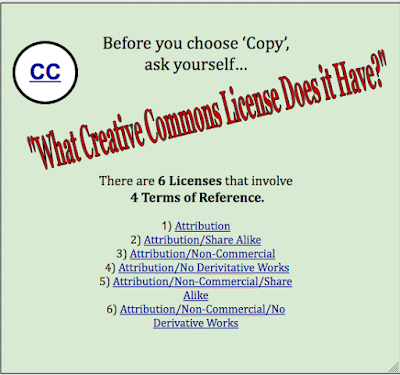
How does this connect to my teaching world?  Over the years I have inevitably seen students who have developed talents and skills in specific areas.  There is usually a student who is known as 'the artist'.  This year I had a proficient 'dragon drawer' as they called him.  It allows for a very good teachable moment the first time another student approaches him and asks him to draw one for their project. It seems simple to them, he does it best why not just ask him? Whether it's online or on paper there are soon multiple sketches around the room all made by the same student.  As presentation time approaches I ask the question, "How have you given credit to the artist?" Quiet room.  I'm sure they are trembling and thinking I will tell them to remove it because it's not theirs.  Perhaps because if it were an art class they instinctually know that you can't get someone else to do your picture.  It's an important lesson for both the taker and the sharer.  What follows is a discussion with a real life example of all the ways the artist can 'license' their work.  It seems to be best if the focus is on protecting the artist and not on what the other students did wrong.  This in-class experience makes the extension to works they create and share online easier to grasp.  As an example, I have created a very simple reminder poster that is meant to be viewed live so that the links are active.  It is a refresher of the 6 licenses and the important terms that students and teachers should know.  Have you created something? Follow this link to Choose the license that best suits you.


Creative Commons License
This work is licensed under a Creative Commons Attribution-NonCommercial-ShareAlike 4.0 International License.

Saturday, 4 July 2015

Why School? Great question!


http://bit.ly/1KAYc9J
Why School?: How Education Must Change When Learning and Information Are Everywhere by Will Richardson (2012)

Wow! What a powerful first 2 chapters!  I just keep rereading them and wishing every educator could too.  I've been lucky enough to have heard Will speak so dynamically at conferences. Now I have the luxury of reading his words enough times to really let it sink in.  The Education System NEEDS to change.  And it's going to whether people like it or not.  Educators, parents, students, community and yes even government are going to have to get out of the 150 year old rut we've been in.  Who will lead us?  How will this message get to policy writers and curriculum 'experts'?  We need a complete revamp.  We need to stop comparing our 'scores' to other countries because they are stuck too! Everyone agrees the world is changing in so many ways so much more quickly than ever before that whatever we do in education had better be adaptable.  Something it hasn't been for a long time.  What should a 2015 school look like?   Maybe his next chapters will offer a glimpse!

Friday, 3 July 2015

Counting on the Web


http://bit.ly/1Cg4IAb
"What does Web 2.0 mean?" Definitely a question I've heard. And if I'm leading a workshop or near a group of teachers, they always seem to stop what they are doing and listen intently to the answer. The first time I was asked (several years ago), I found it daunting to answer, even though I had researched it a bit and talked about it with my colleagues casually. I fell back on a popular Read (1.0) and Read/Write (2.0) description or a one way street and two way street analogy. I wouldn't use those anymore, and I was surprised to discover that the inventor of the World-Wide-Web, Tim Berners-Lee in an article written in 2006, states when discussing the version number, “nobody even knows what it means”.  It was another Tim that coined the phrase 'Web 2.0', Tim O'Reilly. He writes, "it was never meant as a version number." Rather, the expression "was about the return of the web after the dot-com bust," he explains. "There won't be a Web 3.0 until everybody says, 'OK, the web died again,' and we rediscover it." And yet it is common to hear about Web 3.0 and even 4.0 and 5.0 without any web 'death'. It appears to me to be a discrepancy among the 'techies and the lay people' in the computing world.  Since I consider myself to be in the second group, I will continue with those definitions and graphics. 
As early as 2006 you could find articles such as this Bloomberg Business blog that discussed 3.0.  They came up with many predictions and ideas for its definition, pretty amazing since they were still getting used to 2.0.  One of the front runners was to continue the Read - Write idea and add Execute.  It was/is also considered the Semantic Web.   Now the definitions are getting a little more complex.
http://bit.ly/1f9bFZD
In fact, if you really find this interesting you may want to read this article by Flat World Business about 4.0 (The Mobile Web) and 5.0 (The Emotional Web). As a teacher with only a few years left before retirement, I wonder how much 4 and 5 will impact me in the classroom.  I do know that 3.0 certainly has.  These past 2 years have seen activities such as Hour of Code start to have a presence in education. Here in my hometown, Year of Code Waterloo Region launched this week! The events are incredible and the connection to education inevitable. Students are, want to, and are good at content creation. Teachers need to be aware of this and be ready to guide, allow growth and encourage the 3.0 world.  It's all about jumping in!
http://bit.ly/1Cg8YQ7
The student's world is and should be changing.  The potential for every student, regardless of their abilities, to have access to whatever technology will bring them to their full potential is upon us. Whether they need speech to text applications or complex coding activities to challenge them, all students should be allowed to learn at their level.  The field of Special Education should be buzzing with hardware and programs that accommodate student needs at all grade levels. And certainly when it comes to assessment, there should not be an insistence on paper/pencil tasks ever again. Tim and Tim worked hard to bring advancements to our education field, we need to use them.


Thursday, 2 July 2015

Canada Day Chit Chat


Last night the fireworks were wonderful. My neighbourhood loves to get together in the courtyard area and hold a BBQ where we get a chance to catch up with all the news. This year I took the opportunity to ask few of them if they had ever heard of Creative Commons. "Creative Commons is a non-profit organization devoted to expanding the range of creative works available for others to build upon legally and to share." Wikipedia

I focussed mostly on those with children in school.  Here are the results:
Never Heard of it:  21
Sort of Know what it is:  9
Know it:  7  (5 of them are teachers and retired admin.)

Not too surprising, but certainly disappointing.  I think a survey like this points out the importance of teachers modelling Fair Use of content in the classroom. We need to purposely look for opportunities to visually and verbally demonstrate accreditation of other's work.  I like to start with using the student's own work as an example.  This past year I tried out a new idea.  I gathered photos that my students had taken, mixed in a few of my own and put together a slideshow.  I 'let' the students think I had taken them all and didn't put any reference to ownership.  It didn't take long before someone spoke up and said, 'Hey, that's my photo!'  Soon others joined in.  I gave them some time to feel taken advantage of, disrespected, etc.  I even told them I'd be showing the pictures to other teachers and friends.  They got close to outrage!  Teachable moment.  Live it and learn it. Great discussions followed. It made the rest of the year so much easier.  If they ever forgot to credit a picture or quote, they felt bad.  Doesn't get much better than that.  Now what to do about all those adults!
p.s. the photo up top is mine, a burning schoolhouse no less!